


Took it out of the package plugged it in and it works great! glad to have the extra reassurance.
Bundle Sale: Up to 60% Off & Free Shipping!
Bundle Sale: Up to 60% Off & Free Shipping!
Bundle Sale: Up to 60% Off & Free Shipping!
Bundle Sale: Up to 60% Off & Free Shipping!
Bundle Sale: Up to 60% Off & Free Shipping!
Bundle Sale: Up to 60% Off & Free Shipping!
Bundle Sale: Up to 60% Off & Free Shipping!
Bundle Sale: Up to 60% Off & Free Shipping!
Bundle Sale: Up to 60% Off & Free Shipping!
Bundle Sale: Up to 60% Off & Free Shipping!
Bundle Sale: Up to 60% Off & Free Shipping!
Bundle Sale: Up to 60% Off & Free Shipping!
Bundle Sale: Up to 60% Off & Free Shipping!
Bundle Sale: Up to 60% Off & Free Shipping!
Bundle Sale: Up to 60% Off & Free Shipping!
Bundle Sale: Up to 60% Off & Free Shipping!
Pro-Grade Protection For 107,000+ RVers
✔ Real-time readings from 0 PPM.
✔ Alarms at 50 PPM, not 70.
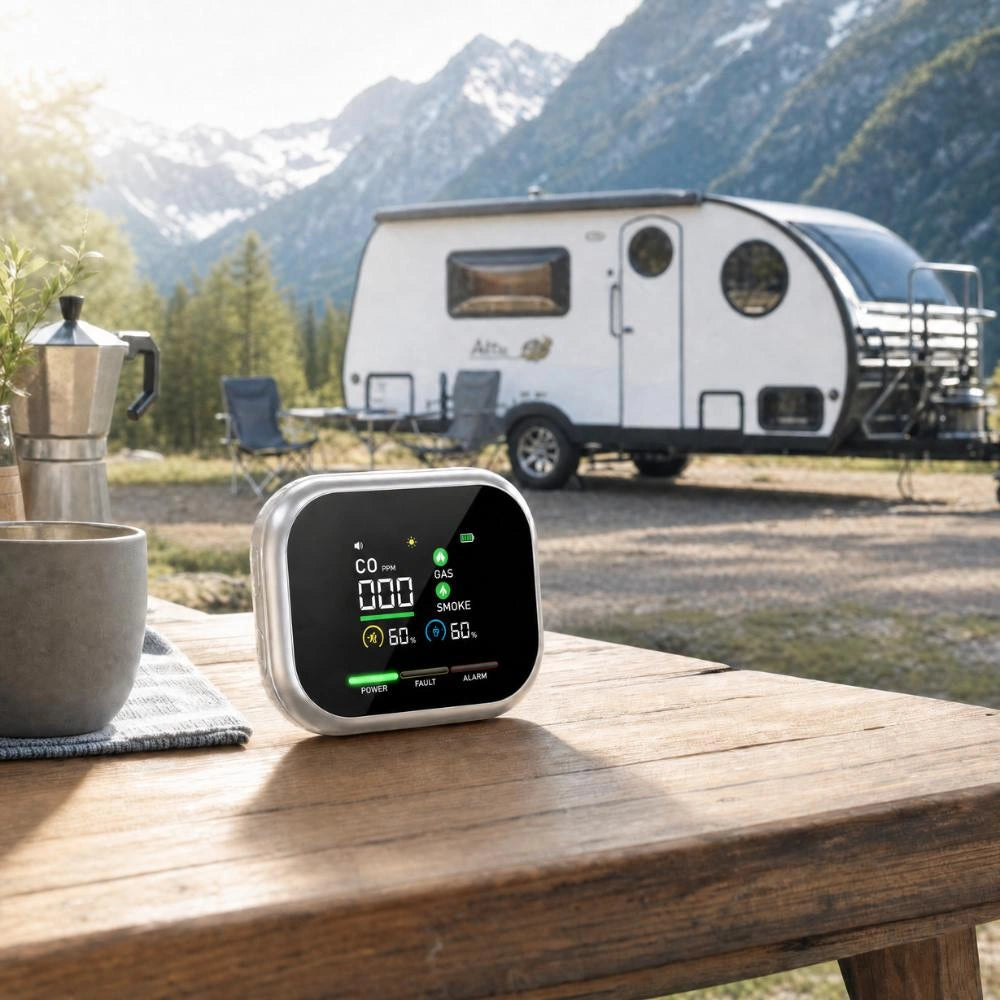
✔ Detects CO, Gas & Smoke in one.
✔ 12-hour battery backup built in.
Couldn't load pickup availability
Plug Nexvur into any outlet in your rig. The color screen lights up
instantly and starts tracking your air in real time. No tools, no wiring,
no app to download.
The built-in 12-hour backup battery charges automatically while plugged in.
When shore power drops or your generator switches off, Nexvur keeps
watching — even off-grid.
For full coverage, place one in each key zone: bedroom, kitchen, living
space. Once installed, they create a permanent safety net for your entire
rig.
Where to avoid: Do not place detectors directly across from stove burners, in front of air vents, or behind curtains.
Your factory detector has a green light that means it has power. It
doesn't tell you what's in the air. Nexvur shows you real CO numbers
from 0 PPM, all the time.
Your factory detector is built to meet the minimum legal standard —
it can wait until 70 PPM (when you're already symptomatic) before it
alarms, and take up to 4 hours to respond. Nexvur alerts you at 50 PPM,
before symptoms start.
Your factory detector is hardwired in one place and goes silent when
power dies. Nexvur plugs into any outlet, comes with you anywhere, and
runs 12 hours on its built-in battery — even off-grid.
Your factory detector only detects CO and propane. Nexvur monitors six
threats: carbon monoxide, propane, natural gas, smoke, temperature,
and humidity.
The green light on your factory detector means it's on.
It doesn't mean you're safe.
Free Shipping
Enjoy free shipping on all orders.
Processing Time
All orders are processed within 1-2 business days. You will receive a confirmation email once your order has been shipped.
Shipping Time
We deliver within 5–8 business days. Delivery times may vary depending on your location.
Tracking
Once your order is shipped, a tracking number will be provided so you can monitor its progress.
We're confident you'll love your Nexvur 6-in-1 CO Detector — but if not, you're fully protected.
You get:
If anything arrives damaged or stops working properly, we replace it free of charge.


60 Days Risk-Free Trial Period
Free Shipping on All Orders
60 Days Risk-Free Trial Period
Free Shipping on All Orders
60 Days Risk-Free Trial Period
Free Shipping on All Orders
60 Days Risk-Free Trial Period
Free Shipping on All Orders
60 Days Risk-Free Trial Period
Free Shipping on All Orders
60 Days Risk-Free Trial Period
Free Shipping on All Orders
60 Days Risk-Free Trial Period
Free Shipping on All Orders
60 Days Risk-Free Trial Period
Free Shipping on All Orders
60 Days Risk-Free Trial Period
Free Shipping on All Orders
60 Days Risk-Free Trial Period
Free Shipping on All Orders
60 Days Risk-Free Trial Period
Free Shipping on All Orders
60 Days Risk-Free Trial Period
Free Shipping on All Orders
60 Days Risk-Free Trial Period
Free Shipping on All Orders
60 Days Risk-Free Trial Period
Free Shipping on All Orders
60 Days Risk-Free Trial Period
Free Shipping on All Orders
60 Days Risk-Free Trial Period
Free Shipping on All Orders
Carbon monoxide builds quietly. Standard detectors only react when levels are already dangerous. Nexvur shows you live readings the moment something changes, giving your family more time to respond.

Master RV technicians know the pattern too well: families trust a “working” factory detector, but the warning comes too late. NEXVUR is built to make rising gas levels visible instantly from 0 PPM, so you have more time to act.

Your factory detector has a green light. That light means it has power. It doesn't tell you what's in the air. Most factory detectors wait until 70 PPM to alarm—and the UL 2034 standard allows them up to 4 hours to respond at that level. At 70 PPM, you've already been breathing poison for hours.
Nexvur shows you real CO levels from 0 PPM in real time. You see danger building before it becomes dangerous—not after.
Yes. Nexvur has an 12-hour built-in backup battery that charges automatically while plugged in. When your shore power drops, your generator switches, or you disconnect for the night—Nexvur keeps watching.
Where to avoid: Do not place detectors directly across from stove burners, in front of air vents, or behind curtains.
Nexvur uses industrial-grade electrochemical and photoelectric sensors with selective gas detection—much less prone to false alarms than older RV detectors. The CO sensor specifically targets carbon monoxide and won't trigger from normal cooking steam, humidity, or aerosol sprays.
Avoid placing it directly across from a stove burner if you cook frequently with high heat.
Yes. Carbon monoxide is just as dangerous at home as on the road, and home detectors expire too, often without you knowing. Nexvur plugs into any standard outlet, so it protects your house just like your rig, especially near where you sleep.
Most factory detectors only let you press a test button that checks the speaker—not the sensor. So you press the button, hear a beep, and assume it's working. The sensor inside could be completely dead and the button would still beep.
With Nexvur, you don't have to guess. The screen shows you real-time numbers. CO at 0 PPM. Temperature. Humidity. The numbers themselves are the proof. If they're changing in response to your environment, the sensors are working.
Yes. Nexvur is built with reinforced housing and solid-state sensors designed for mobile environments. It's been tested for stability through road vibration, temperature shifts, and humidity changes.
For long-term storage or rough roads, you can unplug it and store it in a cabinet—it will retain its calibration when you plug it back in.
Overall rating: 4.8 / 5 from 1263 reviews.
Took it out of the package plugged it in and it works great! glad to have the extra reassurance.

Say to install. Easy to use

Using it for first time in my RV. So far, so good.

Awesome thank you so much !!

Works well....love the readout

At one glance I can read the CO2 PPM, the temp and the humidity. We have frequent power outages here in CA due to PG&E so my li battery takes over automatically. I am using it in my house until I take out the RV then I will use it in the RV. Versatile and useful!

Bought the 2-pack: one for the motorhome and the other for our cabin in the woods as we are on LP there (see pic). Plug n play, clear info display makes it easy to understand. These sensors give us much peace of mind. Highly recommended.

I love my 6 in 1 CO Detector. It looks very high tech but it is very simple to use. With my gas grill off, I place the CO detector inside the grill and turned on the propane. Within seconds the alarm sounded. The temperature displayed on the unit matches the thermostat in my home exactly and I like that the display can be rotated.

Very easy to use and very clear readings! Really like this to monitor and alert any issues!

Really piece of mind for our RV, one in the bedroom and one up by the kitchen. Clear, easy to read display. Would highly recommend it.

My factory detector still works fine, but it always bugged me that I had no idea what the actual level was. The UL standard doesn't make these alarms go off until 70 PPM, and from what I read your body's already taking a hit above 50. So you could be sitting in something harmful and have no clue. That's what got me, the not knowing. Now I can just look at the screen and see exactly where things are at. Sleep a lot easier knowing that.

The screen is bright and easy to read, so I can check CO and gas levels at a glance and it really gives us peace of mind out on the road. I love that it combines several sensors into one unit, which keeps things simple in a small RV space. It also feels solid and well-built, which matters a lot when you're sleeping in a camper with a propane stove and a generator running nearby.

Just unboxed this thing. Feels really solid and looks way more high-tech than the old detector in our motorhome. Can't wait to get it plugged in for our next trip.

I like these detectors. No worries about dead batteries and it detects multiple things. Very nice.

Fast shipping. Tested it out per the manual and the response time is incredibly quick. Putting it in the rig tomorrow.
The CO, Propane, and Smoke alarms seem to work great, but the temperature on all 3 units I ordered is inaccurate. I didn't order a thermometer so overall I am happy with the product.
The temp on it is off by 6-8degrees after being plugged in for 24 plus hours
Works great. Much nicer than the one that’s hard wired
Nice device
Cool
So far so good!
Ordering and delivery went well. We are using it for the first time and so far so good. Hopefully we will be very pleased.
Device works great just as advertised it’s great that it gives you the temperature and humidity readings too
Works Great
Thank you for developing this great product. I immediately installed both of them in my Airstream!
I ranked it merely 4-stars b/c it hasn't detected excessive CO2, but it lights up and shows a measurement. So, I'll suppose that's GOOD.
They were delivered in a timely manner, I bought three . The alarms haven’t gone off to let me know that we have a dangerous amount of gas in the house or or camper. So that’s good.
Have one in home and one in RV. Will be getting three more for Christmas gifts for our children.
Pierced to be very good quality plugged in right by the original one in RV wait to see which one reacts first
High quality. Well made piece of technology. Works great !!
Great product!
Very happy with the product And the service was great
Love the look and simplicity of the digital read-out and really like the digital thermostat. More accurate than our heatpump a/c thermometer. Thanks for developing a great product for the RVer!
Plug and play out of box, bought 3 have one in house and other two are for my RV.
Works great so far.
Great product
Easy operation… Hopefully just as reliable as well.
So far so good!
Put 3 in my 44 ft Fuzion Toyhauler. Look and work great.
Love it